

Author: John Mattiacci | Owner Mattiacci Law
Published March 22, 2026
If you get into a car accident and the other driver is at fault but doesn’t have enough insurance, you’re probably going to have to turn to your own policy to cover your costs. This is a tough pill to swallow, but it’s a reality in Pennsylvania. The state’s minimum liability coverage is so low that it often can’t even begin to pay for serious injuries.
This is exactly why Uninsured/Underinsured Motorist (UM/UIM) coverage exists. It’s designed to fill that dangerous gap.
The Reality Of Pennsylvania's Outdated Insurance Minimums

It’s a situation nobody wants to think about. You’re driving safely, following the rules, when another driver makes a terrible mistake and causes a major crash. You’re hurt, your car is a wreck, and then you discover the gut-wrenching truth: the at-fault driver’s insurance is barely a drop in the bucket.
This isn't some rare, unlucky scenario. It's a common and devastating reality for thousands of accident victims across Pennsylvania. The problem is baked right into the system—the state’s mandatory insurance minimums are dangerously low and haven’t been updated to match the sky-high costs of modern medical care.
A Coverage Gap By Design
Pennsylvania law says every driver must carry a minimum amount of bodily injury liability coverage. This is the insurance that pays for injuries you cause to someone else. Here’s the problem: the required minimum is just $15,000 per person and $30,000 per accident.
That might sound like a lot of money, but it gets eaten up incredibly fast after a serious crash.
Just think about the immediate costs of a moderate injury:
- An ambulance ride and a trip to the ER can easily top $10,000.
- MRIs, CT scans, and other diagnostic tests can add thousands more.
- Then come the follow-up visits with specialists, months of physical therapy, and prescription drugs.
A single serious injury can blow past that $15,000 minimum in just a few days—sometimes a few hours. This is what we call the "coverage gap"—the huge difference between what the other driver’s insurance pays and what your damages actually cost.
The table below shows just how big that gap can be. Pennsylvania's minimums, set decades ago, offer almost no protection against the real-world expenses of a car accident today.
Pennsylvania Minimum Liability vs. Actual Accident Costs
| Expense Type | PA Minimum Coverage | Typical Real-World Cost |
|---|---|---|
| Bodily Injury (per person) | $15,000 | $50,000 – $250,000+ |
| Emergency Room Visit | Not specified | $5,000 – $20,000+ |
| Surgical Procedure | Not specified | $25,000 – $100,000+ |
| Lost Wages (3 months) | Not specified | $10,000 – $25,000+ |
| Physical Therapy | Not specified | $5,000 – $15,000+ |
As you can see, relying on the at-fault driver's minimum policy is a losing game. The numbers just don't add up, leaving you on the hook for tens or even hundreds of thousands of dollars.
A Real-World Example Of The Financial Cliff
Let’s put this into perspective. Imagine you’re driving on I-95 near Philadelphia when a distracted driver slams into your car from behind. They admit fault, but their insurance only covers Pennsylvania's bare minimum: $15,000 for your injuries—a limit set way back in the 1970s under 75 Pa.C.S. § 1702.
Your medical bills hit $25,000 in the first week alone. The other driver’s policy pays out its $15,000 and is completely exhausted. Now what? You’re left with a $10,000 deficit for medical care, and that’s before even thinking about your lost paychecks or the pain you’re going through. You are now holding the bag for tens of thousands of dollars because their policy was completely inadequate. As many sources show, a single ER visit can easily exceed $15,000, a fact you can learn more about in this analysis of Pennsylvania's uninsured motorist laws.
This is the moment of truth for so many drivers. You realize you can't depend on the other driver to make you whole. Your financial recovery depends entirely on the foresight you had when you chose your own auto insurance.
This harsh reality forces a critical shift in perspective. Instead of looking to the at-fault driver for full compensation, you have to turn inward to your own insurance policy. The solution to this dangerous coverage gap isn't in their policy—it's in yours. In the next sections, we'll break down the specific coverages, like Uninsured and Underinsured Motorist protection, that act as your financial safety net in these exact situations.
Your Financial Safety Net: Uninsured And Underinsured Motorist Coverage

When you find out the driver who hit you doesn't have enough insurance to cover your bills, it's easy to think you're out of options. But you're not. This is exactly when your own car insurance policy can step in to save the day. The key is a specific type of coverage you hopefully have: Uninsured Motorist (UM) and Underinsured Motorist (UIM) coverage.
Think of it as your own personal financial backstop. It’s a safety net you paid for, designed for this exact situation—to protect you when the other driver’s insurance falls short. While the at-fault driver’s policy is the first place you look for money, your UM/UIM coverage is the critical reinforcement that fills the gap.
The Two Shields Of UM And UIM Coverage
People often lump UM and UIM coverage together, but they actually protect you from two different—and equally frustrating—scenarios. Knowing the difference helps you understand exactly how you’re covered.
Uninsured Motorist (UM) Coverage: This is for when the at-fault driver has no insurance at all. It also kicks in for hit-and-run accidents where the driver is never found. Your UM coverage basically steps into the shoes of the insurance company that should have been there, paying you the compensation you’re owed.
Underinsured Motorist (UIM) Coverage: This is the one that solves the main problem we’re talking about here. It applies when the at-fault driver does have insurance, but their policy limits are too low to cover everything. Once their insurance pays out its maximum, your UIM coverage can step in to cover the rest, up to your own policy limits.
For example, let’s say your total damages add up to $100,000, but the at-fault driver only has Pennsylvania’s bare-minimum $15,000 liability coverage. After you get that $15,000 from them, your UIM policy can cover the remaining $85,000. Without it, you’d be stuck trying to figure out how to cover that massive shortfall on your own.
What Does UM And UIM Insurance Actually Pay For?
This isn’t just for your leftover medical bills. UM/UIM coverage is designed to pay for the full range of losses you’ve suffered—the same things the at-fault driver’s insurance should have covered. A successful claim can help you recover money for a lot more than you might think.
This breaks down into two main types of damages:
- Economic Damages: These are the straightforward, calculable financial hits you’ve taken. Think past and future medical bills, lost wages from being out of work, and even loss of future earning ability if your injuries are permanent.
- Non-Economic Damages: These are the losses that don’t come with a neat price tag but have a huge impact on your life. This is your compensation for pain and suffering, emotional distress, scarring and disfigurement, and not being able to enjoy your life the way you used to.
In short, UM/UIM is there to cover the same damages you could have pursued in a lawsuit if the other driver had been properly insured. For a deeper dive, you can read our simple explanation of Uninsured and Underinsured Motorist coverage in PA to get more details.
The Twist: You’re Negotiating Against Your Own Insurer
Here’s the part that catches a lot of people by surprise: when you file a UM or UIM claim, you are officially making a claim against your own insurance company. You’re no longer dealing with the other driver’s adjuster. Now, you’re up against your own carrier.
Even though they’re “your” insurance company, their goal in a UM/UIM claim is the same as any other insurer: to protect their own bottom line. They will question your injuries, challenge your medical treatment, and try to pay out as little as possible.
This suddenly puts you in an adversarial relationship with the company you’ve been paying for years. They might argue your injuries aren’t that bad or that some of your treatment wasn't necessary. It can be a real shock.
This is exactly why you need an experienced lawyer in your corner. A good attorney knows how to gather the right evidence, build a powerful case for what your claim is truly worth, and handle all the tough negotiations. They’ll make sure your own insurance company honors the policy you paid for and fights to get you the full and fair compensation you deserve.
How To Multiply Your Coverage With Stacking
When you’re hit by a driver who doesn’t have enough insurance, your own Underinsured Motorist (UIM) coverage is your primary safety net. But what happens if your injuries are so severe that your damages blow past even your own policy limits? In Pennsylvania, there's a powerful option called stacking that can make a massive difference.
Think of it this way: stacking lets you legally combine the UIM coverage from each vehicle on your policy into one large pool. It’s like taking the individual "blocks" of coverage for each car and literally stacking them on top of each other to build a much stronger financial wall for a single accident.
Let's Walk Through A Stacking Example
The best way to get how stacking works is to see it in a real-world scenario. Let’s say you have a pretty standard auto policy covering two of your family’s cars.
- Your Policy: You insure two cars, a sedan and an SUV.
- Your UIM Coverage: You made the smart choice to buy $100,000 in UIM coverage.
- Your Choice: When you bought the policy, you elected to stack your coverage.
A few months later, you're badly injured in a wreck caused by a driver who was underinsured. Your total damages—for medical bills, lost wages, and your pain and suffering—add up to $175,000. The at-fault driver only carries the Pennsylvania state minimum of $15,000, which you get.
Now you’re still short $160,000. Because you chose to stack, you can combine the UIM coverage from both of your vehicles.
$100,000 (from Car 1) + $100,000 (from Car 2) = $200,000 in Total Available UIM Coverage
With your stacked policy, you have a $200,000 fund to draw from. That’s more than enough to cover the remaining $160,000 you need. If you hadn't stacked, you’d be stuck with just $100,000, leaving you to eat a $60,000 loss on your own.
The Critical Choice: To Stack Or Not To Stack
In Pennsylvania, your insurance company is legally required to offer you stacking when you buy or renew your policy. You have to actively choose one way or the other.
- Electing Stacking: You pay a bit more for your premium, but you get the massive benefit of multiplying your coverage like in the example above. The extra cost is usually tiny compared to the protection it offers.
- Waiving Stacking: You sign a waiver form to officially reject stacking, typically to save a few bucks on your premium. By doing this, you are capped at the UIM limit for a single vehicle, even if you insure three or four cars on that same policy.
This is one of the single most important decisions you'll make when buying car insurance. Waiving stacking to save a little money can turn into a financially devastating mistake if a seriously underinsured driver ever hits you. That extra layer of protection is absolutely worth it.
It's also good to know that the laws around this are constantly being fine-tuned. For example, recent legislative updates through 2026 have further clarified how stacking works, reinforcing how coverage can be multiplied to give accident victims better protection. You can learn more about these complex Pennsylvania insurance laws and their updates to stay on top of your rights.
Why Stacking Is A Must-Have In Pennsylvania
Let’s be blunt: Pennsylvania’s minimum insurance requirement is a dangerously low $15,000. That means the odds of getting hit by someone without enough coverage to pay for serious injuries are incredibly high. Stacking is your best defense against this reality. It allows you to build your own safety net so you aren't left depending on the bad decisions of other drivers.
Figuring out a UIM claim, especially when stacking is involved, gets complicated fast. It requires a deep dive into insurance contracts and Pennsylvania law. An experienced personal injury lawyer knows how to analyze every possible policy—including those of relatives living in your house—to uncover all available coverage. We make sure you get the maximum recovery by using these complex but powerful rules to your advantage, giving you the best shot at being made whole again.
Managing Immediate Medical Bills With PIP And Health Insurance
While you’re trying to figure out the underinsured motorist (UIM) claim, your medical bills won't be sitting on the sidelines. They start rolling in almost immediately, adding a ton of stress when you should be focused on getting better. So what happens if the other driver doesn’t have enough insurance in Pennsylvania to cover those costs right away?
The good news is, there’s a clear system for this in PA. It all starts with your own car insurance policy.
Pennsylvania is what’s called a "choice no-fault" state. In simple terms, this means that no matter who caused the crash, your own Personal Injury Protection (PIP) coverage is the first in line to pay your medical bills. Think of it as your own personal health fund just for car accidents.
Your First Line of Defense: Your PIP Coverage
Right after a collision, your PIP benefits kick in to pay for your medical care. This covers everything from the ambulance and ER visit to your follow-up appointments with doctors and physical therapists. The whole point is to make sure you can get the treatment you need without waiting for the at-fault driver's insurance company to cut a check.
Here’s the problem: the mandatory minimum for PIP in Pennsylvania is only $5,000. If your injuries are serious, you can burn through that amount in a single day. This is exactly why we always tell clients to buy higher PIP limits—$10,000 or more is a much safer cushion. To get a better handle on this critical coverage, you can check out our detailed guide on how PIP affects your accident claim in Pennsylvania.
The Payment Sequence After PIP Is Exhausted
Once your PIP is all used up, the responsibility for paying your bills shifts. It follows a specific order, and it’s important to understand how it works.
- Your Health Insurance: After your PIP is maxed out, your private health insurance company steps in. You’ll use it just like you would for any other illness or injury, which means you'll be on the hook for your usual deductibles and copayments.
- The At-Fault Driver's Insurance: Next, we go after the other driver’s bodily injury liability policy. Their minimum coverage is just $15,000, which often isn't nearly enough to cover everything.
- Your Underinsured Motorist (UIM) Coverage: This is the final and most critical step. Your UIM claim is designed to pick up all the remaining pieces. It pays for your future medical care, reimburses your health insurer for what they paid out, covers your deductibles and copays, and compensates you for lost wages and your pain and suffering.
The whole point of a UIM claim is to make you financially whole again. It acts as the ultimate safety net, stepping in to cover all the leftover costs so the financial burden of a crash you didn't cause doesn’t land on your shoulders.
This infographic shows how another part of your policy, stacking, can boost your total available coverage even further.
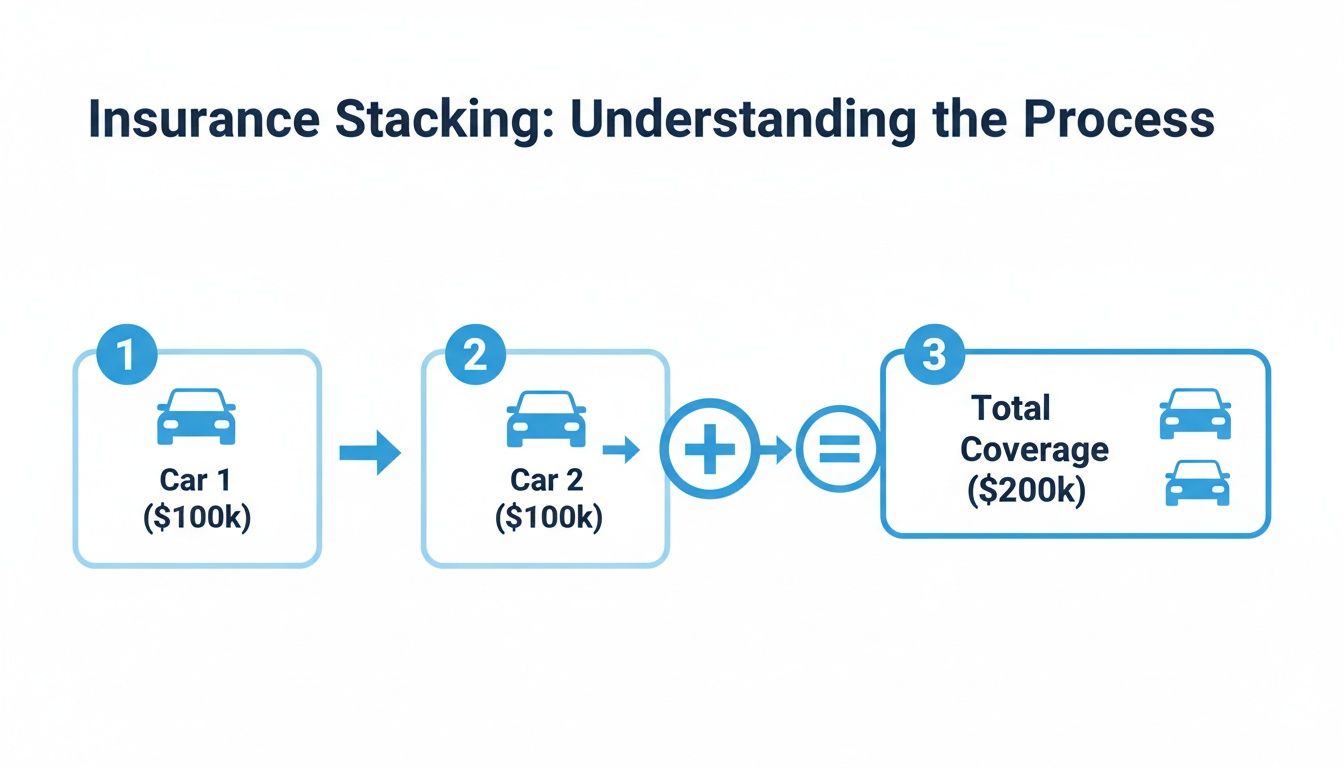
As you can see, stacking essentially combines the coverage from multiple vehicles to give you a much bigger pot of money to draw from after a single accident.
Juggling this payment sequence and making sure every insurance company pays what it owes is complicated. An experienced lawyer can handle all the communications with your PIP carrier and health insurer, manage the paperwork, and build the strong UIM claim you need to get a complete financial recovery.
Can You Sue The Underinsured Driver Personally?
When you find out the driver who hit you doesn't have enough insurance to cover your bills, the first question on your mind is probably, "Can I just sue the person who caused all this?" The short answer is yes. Legally, you absolutely have the right to file a personal injury lawsuit directly against the at-fault driver to get your money back.
But just because you can sue them doesn't mean you should. In the real world of personal injury law, winning a lawsuit and actually collecting the money you're owed are two completely different things.
The Problem: What If They're "Judgment-Proof"?
The single biggest roadblock you’ll likely hit is a concept called being judgment-proof. This is a term for someone who simply doesn’t have enough personal assets or income to pay a court-ordered judgment. Even if you go to court and a judge awards you $100,000, that piece of paper is worthless if the person you sued has no money, no property, and no way to pay you.
A person is usually judgment-proof if they have:
- Little to no money in their bank accounts.
- No valuable assets like real estate, investments, or expensive cars.
- A low-income job where their wages can’t be garnished effectively.
Chasing a judgment-proof driver often becomes a frustrating and expensive dead end. You could spend thousands in legal fees to win your case, only to discover there’s no money to collect at the end of the road.
This is a dose of harsh realism in personal injury law. The ability to win a case in court is irrelevant if the defendant has empty pockets. It’s why focusing on insurance coverage is almost always the smarter, more effective strategy.
The Smarter Path: A UIM Claim
This is precisely why Underinsured Motorist (UIM) coverage is so critical in Pennsylvania. Instead of starting an uncertain and often pointless lawsuit against the driver, a UIM claim lets you turn to your own insurance company for the compensation you need. It's a much more reliable and efficient way to get back on your feet.
Think of it like choosing a paved highway over a bumpy, treacherous dirt road. Your UIM claim is a contractual right you have with your insurer—a predictable process designed for this exact scenario. A personal lawsuit, on the other hand, is a gamble on the at-fault driver’s personal bank account.
Without UIM coverage, you're pretty much stuck chasing the driver personally, which is a huge challenge if they're judgment-proof. This is where an experienced firm like Mattiacci Law can make all the difference, using your UIM claim to bridge that financial gap, either through skilled negotiation or, if needed, a lawsuit against your own carrier. You can find more details about how this works on this Pennsylvania uninsured motorist law resource.
While the idea of holding the at-fault driver personally accountable is satisfying, the main goal after an accident is to get the financial help you need to heal and move on. A good attorney will always focus on maximizing your recovery through every available insurance policy first. It’s the most secure path to getting the compensation you deserve without the uncertainty and frustration of a personal lawsuit.
Strategic Steps To Secure Your Full Compensation
After a crash with a driver who doesn't have enough insurance, it’s normal to feel overwhelmed. You know Pennsylvania’s minimums are ridiculously low, you've learned about UM/UIM coverage, and you see the power of stacking. But how do you put all that knowledge into action?
Let's turn theory into a concrete game plan. Getting fair compensation isn’t about luck; it’s about taking the right steps, starting from the moment of the crash. The goal is simple: build a rock-solid, evidence-based case so the insurance companies have nowhere to hide. A good lawyer handles this for you, taking the weight off your shoulders and setting you up for success from day one.
Launching An Immediate Investigation
The first 48 hours after a crash are absolutely critical. Evidence has a way of disappearing fast. We start our investigation immediately to lock down the facts before they vanish. This goes way beyond just grabbing the police report; it's about building an undeniable case that establishes fault and shows the true extent of what happened.
Our immediate investigation usually involves:
- Securing the Scene: Getting photos and videos of the damaged vehicles, skid marks, road conditions, and anything else that tells the story.
- Interviewing Witnesses: Finding anyone who saw the crash and talking to them while their memories are still sharp.
- Preserving Evidence: Sending out legal notices to the at-fault driver or nearby businesses, demanding they don’t delete or destroy crucial video footage or vehicle data.
This initial legwork is the foundation of your entire claim. It stops insurance adjusters from trying to twist the facts or shift the blame, giving us a strong starting point for every negotiation to come.
Uncovering All Available Insurance Coverage
One of the most important things we do is hunt down every single dollar of available insurance coverage. What happens if the other driver doesn’t have enough insurance in Pennsylvania? The answer often lies in finding hidden pockets of money you didn't even know existed.
Your recovery isn't just limited to the obvious policies. A thorough attorney digs into every possible source, from the policies of relatives living in your home to umbrella policies, to find the maximum funds available to compensate you.
We'll pore over your own policy, the at-fault driver’s policy, and any other contract that could be relevant. This is how we identify all layers of coverage, including stacked UM/UIM benefits, to make sure we're aiming for the highest possible recovery. This can get tricky, especially if the other driver is uncooperative. You can learn more in our guide on what to do if the other driver refuses to give insurance information.
From there, we take over completely. We handle all the calls with insurance adjusters, manage the complicated deadlines, and do all the negotiating. By calculating every dollar of your damages—from your current medical bills to your future lost income—we build a powerful demand package. This detailed, strategic approach is how we turn a tough situation into a successful recovery.
Frequently Asked Questions About Underinsured Accidents In PA
Dealing with an underinsured driver claim raises a ton of questions. You need straight answers to understand your rights and figure out what happens when the at-fault driver’s insurance just isn’t enough. Here are some of the most common questions we get from clients in Pennsylvania.
What Happens If I Signed The Waiver For UM/UIM Coverage?
If you signed the waiver for Uninsured/Underinsured Motorist (UM/UIM) coverage, you might think your hands are tied. But that's not always the end of the story.
Pennsylvania law is incredibly strict about how insurance companies present these waivers. The rules are laid out in 75 Pa.C.S. § 1731, and if the insurance company messed up, the waiver might not be valid. We're talking about tiny details, like using the wrong font size or incorrect legal wording. An experienced attorney can tear that form apart looking for mistakes. If we find one, the waiver can be thrown out, forcing the insurer to provide the coverage you need.
How Long Do I Have To File A UIM Claim In Pennsylvania?
This one trips a lot of people up. You have two years to sue the at-fault driver, but the deadline for a UIM claim is different. It’s controlled by the contract language in your own insurance policy. Most PA policies give you four years from the date of the accident, but you have to check your specific policy to be sure.
It’s critical to remember there are two key deadlines: the statute of limitations to file a lawsuit and the notice requirement. You must provide prompt notice of the potential claim to your insurer soon after the accident. Waiting too long can jeopardize your case entirely.
Will My Insurance Premiums Increase If I File A UIM Claim?
No. This is a huge worry for a lot of people, but Pennsylvania law is on your side here. Your insurance company is legally forbidden from jacking up your rates, canceling your policy, or refusing to renew it just because you filed a UIM claim for a crash that was not your fault.
Think of it this way: this is a benefit you paid for. You should never be punished for using the exact protection you were smart enough to buy. If an insurer tries to raise your rates after a not-at-fault UIM claim, they could be acting in bad faith—and that gives you a whole new reason to take legal action against them.
Navigating the maze of an underinsured motorist claim takes a deep understanding of Pennsylvania insurance law. The team at Mattiacci Law digs into every detail, from hunting down invalid waivers to uncovering every possible source of coverage. Our goal is to make sure you get the full compensation you deserve. If a driver with low insurance limits injured you, contact us today for a free, no-obligation consultation to go over your rights and options. Visit us at https://jminjurylawyer.com to get the help you need.