


Author: John Mattiacci | Owner Mattiacci Law
Published February 3, 2026

When it comes to personal injury cases in Pennsylvania, there’s one number you absolutely must remember: two. For most situations, you have exactly two years from the date you were injured to file a lawsuit.
This critical deadline is called the statute of limitations. Think of it as a legal stopwatch that starts the moment you’re hurt. If you miss that two-year cutoff, your right to seek compensation is almost always gone for good.
The Two-Year Countdown in Pennsylvania: What It Means for You
Imagine a legal countdown clock. The second an injury happens—whether it’s from a car accident on the Schuylkill, a slip and fall in a grocery store, or any other incident caused by someone else’s negligence—that two-year clock begins to tick.
This isn’t just a guideline; it’s a hard and fast rule set in stone by Pennsylvania law. The reasoning is pretty straightforward: it encourages people to bring claims forward while evidence is still available and memories are fresh. For you, the injured person, it means time is not on your side.
The Standard Deadline for Most Injury Claims
The two-year rule is the go-to for the overwhelming majority of personal injury cases. This includes common scenarios like:
- Car, truck, and motorcycle accidents
- Slip and fall incidents
- Premises liability claims (injuries on someone else’s property)
- Dog bites
So, if your accident happened on July 1, 2024, your final deadline to file a lawsuit is July 1, 2026. It’s that simple, and it’s that strict. Two years can sound like a long time, but when you’re juggling doctor’s appointments, recovering from injuries, and dealing with insurance adjusters, that time disappears faster than you’d think.
You can find more detailed insights about Pennsylvania’s statute of limitations on pribanic.com to see how this applies across different case types.
Key Takeaway: The clock starts on the day of the injury, not the day you finish medical treatment or first speak to a lawyer. Delay is the single biggest enemy of a successful personal injury claim.
Why This Deadline Is So Critical
Let’s be clear: missing the statute of limitations isn’t a simple procedural hiccup. It’s a fatal blow to your case.
If you try to file a lawsuit even one day late, the person or company you’re suing will immediately ask the court to throw it out. And the court will almost certainly agree. Just like that, your legal right to recover a single penny for your medical bills, lost wages, and pain and suffering vanishes forever.
Insurance companies are experts on this. They know the deadline down to the day and have zero obligation to remind you it’s approaching. In fact, it’s a common tactic for an adjuster to delay negotiations, stringing you along with lowball offers, hoping you’ll let the clock run out. Once it does, they can legally walk away without paying you anything.
This is exactly why understanding the two-year deadline is the first and most crucial step in protecting your rights. It dictates the urgency of everything that follows, from preserving evidence to calling an attorney.
When the Filing Clock Can Be Paused or Extended
While Pennsylvania’s two-year statute of limitations feels like a hard and fast rule, it isn’t set in stone. The law is smart enough to recognize that life is messy and some situations just don’t fit neatly into a two-year box. There are a few crucial exceptions that can pause, or “toll,” this deadline, giving you more time to act.
These exceptions are lifelines for people who, for reasons beyond their control, couldn’t have possibly filed their claim within the standard window. If you’re worried it might be too late to file your lawsuit, it’s worth seeing if your situation fits one of these scenarios.
The Discovery Rule for Hidden Injuries
The biggest and most common exception is what we lawyers call the discovery rule. The logic behind it is simple: you can’t be expected to sue someone for an injury you don’t even know you have.
Under this rule, the two-year clock doesn’t start ticking on the day the negligence happened. Instead, it starts on the day you discovered your injury or the day you reasonably should have discovered it through due diligence.
This comes up most often in cases where the damage isn’t immediately obvious.
- Medical Malpractice: Imagine a surgeon accidentally leaves a sponge inside a patient. The patient suffers from mysterious abdominal pain for years. The clock doesn’t start from the date of the surgery; it starts when a later CT scan finally reveals the foreign object.
- Toxic Exposure: A factory worker breathes in harmful chemicals for a decade and then, five years after retiring, is diagnosed with a rare lung cancer linked to that exposure. The clock starts at the time of diagnosis, not their last day on the job.
- Faulty Medical Implants: Someone gets a hip replacement that works fine for years before it starts to fail, leaking metal ions into their bloodstream and causing severe health issues. The statute of limitations would likely begin when they discover the implant is the root cause of their problems.
This flowchart shows how the standard timeline can be altered by these kinds of exceptions.
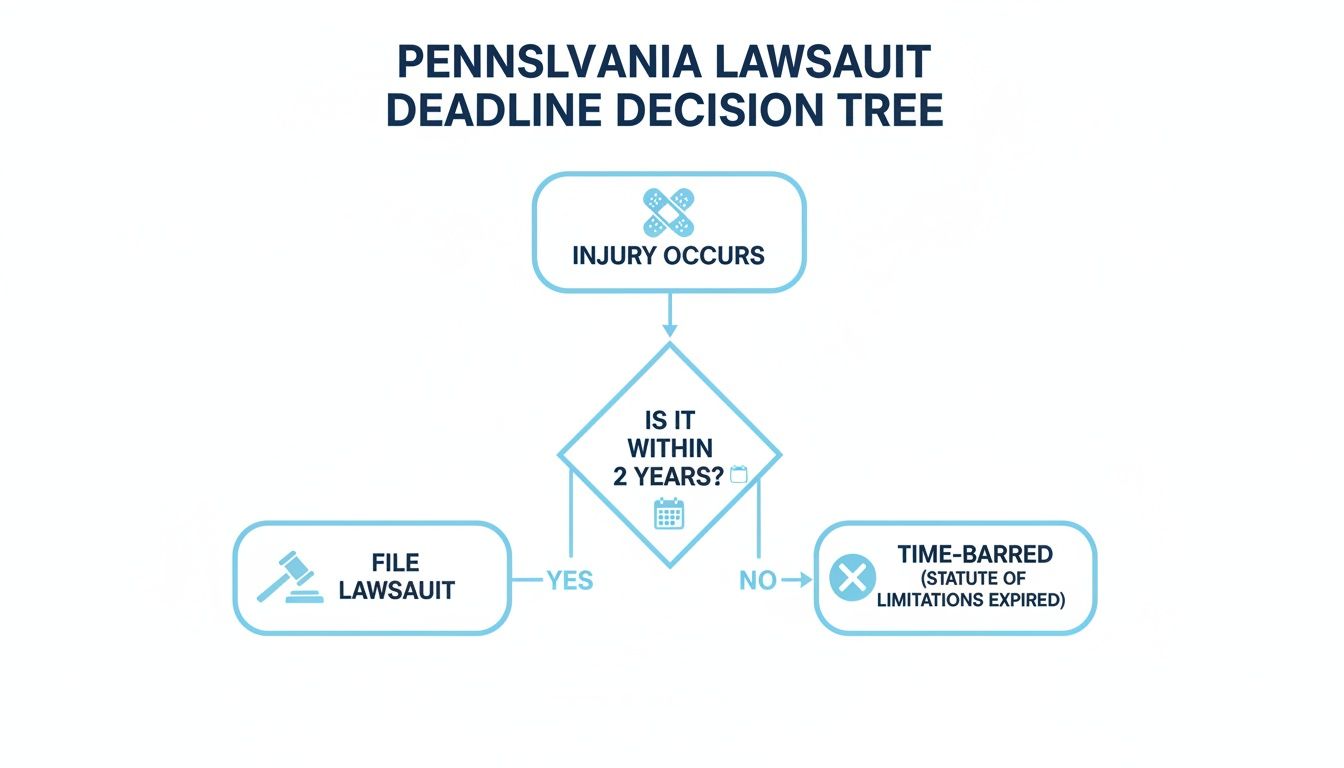
As you can see, while the two-year deadline is the default path, the discovery rule can create an entirely different route, opening the door to a lawsuit long after the initial event occurred.
Protections for Minors and Incapacitated Individuals
Pennsylvania law also builds in safeguards for people who legally can’t file a lawsuit on their own. This is where the legal concept of tolling comes into play. Tolling simply means the statute of limitations clock is paused.
Key Insight: Tolling doesn’t rewind the clock or add extra time. It just presses the pause button, stopping the clock from running until the person is legally able to pursue their own claim. This ensures a person’s right to justice isn’t forfeited simply due to their age or a severe disability.
Two main groups get the benefit of tolling:
- Injured Minors: When a child under 18 is hurt, the two-year clock is frozen. It doesn’t start ticking until they turn 18. This gives them until their 20th birthday to file a lawsuit for an injury they suffered as a child.
- Legally Incapacitated Persons: If an adult is so severely injured (e.g., a traumatic brain injury) that they are declared legally incapacitated, the clock is paused for as long as that incapacitation lasts. Should they ever regain their legal capacity, the clock would start running from that point.
These exceptions aren’t automatic. Proving when an injury “should have been discovered” or establishing the exact period of legal incapacitation can be a real fight, often requiring solid evidence and testimony from experts. You can learn more about the complexities of when does the statute of limitations start in a PA injury case to better understand these nuances.
Because these rules add another layer of complexity, you should never just assume your deadline has passed. The only way to know for sure if your filing clock can be paused or extended is to speak with an experienced personal injury attorney.
Navigating Medical Malpractice and Wrongful Death Claims
While most personal injury cases follow the same two-year deadline, some of the most sensitive claims—medical malpractice and wrongful death—have their own complex rules. The standard two-year clock is still in play, but the real question is when that clock actually starts ticking.
Getting this wrong can be devastating for a family grappling with a medical error or the loss of a loved one. These aren’t just legal cases; they’re deeply personal, and the law has specific timelines that demand a precise and experienced hand.

Medical Malpractice: The Discovery Rule and a Firm Cutoff
In a medical malpractice case, the discovery rule is your most important concept. As we mentioned earlier, it means the two-year clock doesn’t begin when the mistake happened. Instead, it starts on the day you found out—or reasonably should have found out—that medical negligence caused you harm.
Think about a surgeon who makes a mistake during an operation that you don’t feel the effects of for months. The clock wouldn’t start on the day of the surgery. It would begin when another doctor finally identifies the problem and connects it back to the original procedure. It’s only fair, since you had no way of knowing about the negligence any earlier.
But there’s a major catch in Pennsylvania law, called the statute of repose.
The Statute of Repose: Pennsylvania puts a hard stop on things with a seven-year absolute deadline from the date of the malpractice itself. It doesn’t matter when you discovered the injury; once seven years have passed, your right to file a lawsuit is almost always gone.
This rule is designed to give healthcare providers some finality, but it can create harsh outcomes for patients. There’s really only one common exception: if a foreign object, like a surgical sponge or clamp, was left inside your body. In that very specific situation, the seven-year cutoff doesn’t apply.
Wrongful Death Claims: A Different Starting Point
When someone’s death results from the negligence of another person or company, the surviving family may be able to file a wrongful death lawsuit. These are incredibly difficult situations, and the law provides a separate timeline for seeking justice.
The statute of limitations for a wrongful death claim in Pennsylvania is two years. The key difference is the starting point.
For wrongful death cases, that two-year countdown begins on the date of the person’s death. It does not start on the date of the accident or negligent act that ultimately led to their passing.
- For example: Imagine a construction worker suffers a serious injury on the job in 2023. After a long fight, he tragically passes away from those injuries on May 10, 2025. His family would have until May 10, 2027, to file their wrongful death claim.
This distinction is critical. It recognizes that the true loss occurs at the time of death and gives grieving families a fair opportunity to act, even if years have passed since the initial incident. You can dive deeper into the time requirements for filing a wrongful death suit in Pennsylvania to better understand the nuances of these important cases.
Suing a Government Entity and Its Six-Month Notice Rule
Taking on a private company after an injury is one thing. But when you need to sue a government body in Pennsylvania, you’re playing by an entirely different set of rules. Whether your injury was caused by the city, a state agency, or a public transit authority like SEPTA, the clock starts ticking much, much faster.
This isn’t just a small procedural hiccup; it’s a critical legal tripwire that can end your case before it even gets off the ground. While the standard two-year statute of limitations for personal injury still exists in the background, there’s a vital first step with its own unforgiving timeline.

The Mandatory Six-Month Notice of Claim
Before you can even file a lawsuit against a government entity, Pennsylvania law demands you provide them with a formal Notice of Claim. This official written notice must be delivered within just six months from the date your injury occurred.
Think of it as a mandatory heads-up. It lets the government agency know you intend to seek compensation and gives them a chance to investigate what happened. If you blow past this six-month deadline, your right to sue is almost certainly gone for good, no matter how clear-cut your case might seem.
Critical Alert: This six-month notice is an entirely separate requirement from the two-year statute of limitations. You have to meet both deadlines. But if you fail to file the notice within six months, the two-year deadline becomes meaningless because your claim will be blocked right out of the gate.
Real-World Scenarios Where This Rule Applies
This special rule covers a surprisingly wide range of incidents that you might not immediately recognize as a “government case.” It’s absolutely essential to know when you’re dealing with a public entity.
Here are a few common examples:
- Public Transit Accidents: You’re hurt while riding a city bus, like a SEPTA bus in Philadelphia.
- Slip and Falls on Public Property: You trip over a broken, unrepaired sidewalk maintained by the city or fall inside a state-owned building.
- Accidents with Government Vehicles: A public works truck, a police car, or another vehicle owned by a local municipality hits your car.
- Injuries at Public Schools or Parks: A child is injured due to a dangerous condition at a public school or on faulty playground equipment at a city park.
In every one of these situations, that six-month notice clock starts ticking right away. It’s a much tighter window than people expect, making it one of the easiest and most costly deadlines to miss. If you’re asking if it is too late to file a personal injury lawsuit in Pennsylvania after an incident like this, the very first question is whether that notice was filed on time. The nuances involved are exactly why you should learn more about the specific requirements for government injury claims and special deadlines in Pennsylvania.
The Clock Is Ticking: What to Do If Your Deadline Is Near
Seeing that two-year deadline on the horizon can be incredibly stressful. It’s easy to feel overwhelmed, but now is not the time to panic—it’s time to act. What you do in the next few days could be the difference between getting the compensation you deserve and walking away with nothing.
Let’s cut right to the chase: your first and most critical move is to call a personal injury lawyer. Immediately. Don’t put it off until tomorrow. An experienced attorney knows exactly how to handle a fast-approaching deadline and can often file the initial court documents—known as a complaint—in a matter of hours if needed. That simple act officially freezes the statute of limitations clock and protects your case.
Getting Ready for Your First Call
To hit the ground running, you’ll want to have your information organized before you speak with an attorney. A little prep work goes a long way, helping them quickly understand what happened so they can take immediate action.
Your mission is to give them a clear, concise picture of the accident and its impact on your life. This isn’t about building a perfect case on your own; it’s about giving the lawyer the essential information they need to protect your rights before it’s too late.
Think of it this way: You’re not expected to fight the fire yourself. You just need to show the firefighters where the emergency is and hand them the hose. Your documentation is the hose.
Your Essential Document Checklist
Grab a folder or create a new one on your computer and start collecting everything you can find related to your injury. Don’t stress if you can’t find every single item—just gather what you have.
- Official Reports: Any police reports from a car crash or incident reports from a slip and fall at a business.
- Medical Paperwork: This is huge. Gather everything from hospital discharge summaries and physical therapy notes to every bill you’ve received. Making sure all your paperwork is in order, including any specific personal injury form filled out by your doctors, is crucial when you’re against the clock.
- Photos and Videos: Any pictures or videos you took of the scene, your injuries, or damage to your car or other property.
- Witness Contact Info: A simple list of names and phone numbers for anyone who saw what happened.
- Proof of Lost Income: Pay stubs are perfect for this. A letter from your HR department also works.
- Insurance Communications: Any emails, letters, or notes you have from your conversations with insurance adjusters.
Once you have this together, you’re ready to make the call. Remember, personal injury attorneys work on a contingency basis and offer free consultations. You have nothing to lose by reaching out and everything to gain. The real risk is doing nothing and letting your chance for justice disappear for good.
What to Do If You Think You’ve Missed the Filing Deadline
It’s a heart-stopping moment: the realization that the two-year deadline for your personal injury claim might have already passed. The feeling is often a mix of panic and regret, a sense that you’ve lost your only chance for justice. But before you give up, take a deep breath. The date of your injury isn’t always the end of the story.
Think of the statute of limitations as a very strict rule, but one that comes with a few important exceptions. As we covered earlier, these exceptions exist for specific, valid reasons, and your situation might just fit into one without you even knowing it. The last thing you want to do is make a snap judgment on your own case.
Never Assume It’s Too Late to Act
The single biggest mistake you can make is to decide for yourself that time has run out. Personal injury law is incredibly nuanced, and what seems like a hard-and-fast deadline can be more flexible than you think. Only a legal professional can analyze the specific facts of your case and determine if an exception applies.
For example, the discovery rule can be a game-changer. You might assume your two-year clock started ticking on the day of the accident, but if your injury wasn’t immediately obvious, the law might say your deadline started much later—on the day you discovered (or reasonably should have discovered) the harm.
Assuming your case is expired could mean walking away from the compensation you rightfully deserve. The only way to know for sure is to have an expert review the details.
An Experienced Attorney Can Uncover Your Options
A skilled personal injury lawyer essentially becomes a timeline detective for your case. They know precisely which questions to ask and where to dig for evidence that could legally extend your filing window.
They’ll pore over every detail, looking for critical factors you might have overlooked, such as:
- A Delayed Diagnosis: When did you actually learn about the full extent of your injury and connect it to the original incident?
- Tolling for a Minor: Were you under the age of 18 at the time you were hurt?
- Complexities with Government Defendants: Was a government entity involved? Their unique rules can sometimes alter the standard timeline.
It’s completely understandable to feel discouraged if you think the deadline has passed. But please, don’t let that feeling be your final verdict. The law is full of complexities and potential pathways you probably aren’t aware of. Letting a simple misunderstanding stop you from seeking justice would be a tragedy. The only way to get a definitive answer—and some peace of mind—is through a thorough case review with a qualified attorney.
Frequently Asked Questions About Pennsylvania Injury Lawsuit Deadlines
When you’re dealing with the stress of an injury, legal deadlines can feel overwhelming. It’s only natural to have a lot of questions. Getting straight answers is the first step toward protecting your rights, so let’s walk through some of the most common questions we hear from clients.
Does Negotiating with an Insurance Company Pause the Filing Deadline?
This is a critical point that trips up many people: No, it absolutely does not. Talking with an insurance adjuster, no matter how productive it seems, does not stop the two-year clock from ticking down.
Insurance companies know this rule inside and out. Some will even intentionally drag out negotiations, making you think a fair settlement is just around the corner. They hope you’ll get so focused on the back-and-forth that you miss the legal deadline. The moment that happens, their legal duty to pay you evaporates. You must file a lawsuit to preserve your claim, even if you’re still in the middle of settlement talks.
What if the Person Who Injured Me Left Pennsylvania?
Life gets complicated, and sometimes the person responsible for your injuries leaves the state. If the at-fault party is gone from Pennsylvania for four or more consecutive months, or if they are actively hiding to avoid being served with court papers, the law might “toll” (or pause) the statute of limitations.
This rule exists to stop people from just running from their responsibilities. But, proving that someone left for that long or was intentionally hiding can be a tough legal hurdle. It’s a possibility, but one that definitely needs an experienced attorney to sort out.
Can I Still Sue if I Was Partially at Fault?
Yes, you can. Pennsylvania operates under a system called “modified comparative negligence.” It’s a bit of a mouthful, but the concept is fairly simple. You can still recover money for your injuries as long as you weren’t 51% or more to blame for what happened.
How does it work in practice? Your final compensation is just reduced by your share of the fault. For example, if a jury decides you were 20% responsible for the accident, your total award would be cut by 20%. The key thing to remember is that this rule doesn’t change the two-year filing deadline.
Key Takeaway: In Pennsylvania, being a little bit at fault doesn’t shut the door on your case. What truly matters is your specific percentage of responsibility.
What Is the Difference Between an Insurance Claim and a Lawsuit?
Think of an insurance claim as the first step. It’s the formal request you make directly to an insurance company, asking them to cover your damages. A lawsuit, on the other hand, is the official legal action you file in court.
Nearly every case starts out as an insurance claim. But if the insurer refuses to pay, makes a ridiculously low offer, or just gives you the runaround, filing a lawsuit is your only real leverage. It’s the step that forces them to take your claim seriously and preserves your right to let a court decide what you’re owed. Of course, the best strategy is always prevention, especially when it comes to common accidents, which is why resources on How to Prevent Elderly Falls are so valuable.
The legal deadlines in Pennsylvania are strict, but you don’t have to figure them out on your own. If you’re worried about your timeline or just don’t know what to do next, the team at Mattiacci Law is here to give you the clear answers and decisive action you need. We offer a free, no-obligation consultation to go over your case and explain your options. Contact us 24/7 to protect your rights before it’s too late. Visit us at https://jminjurylawyer.com to get started.